


Institutional Backbone of the Disaster Response System  

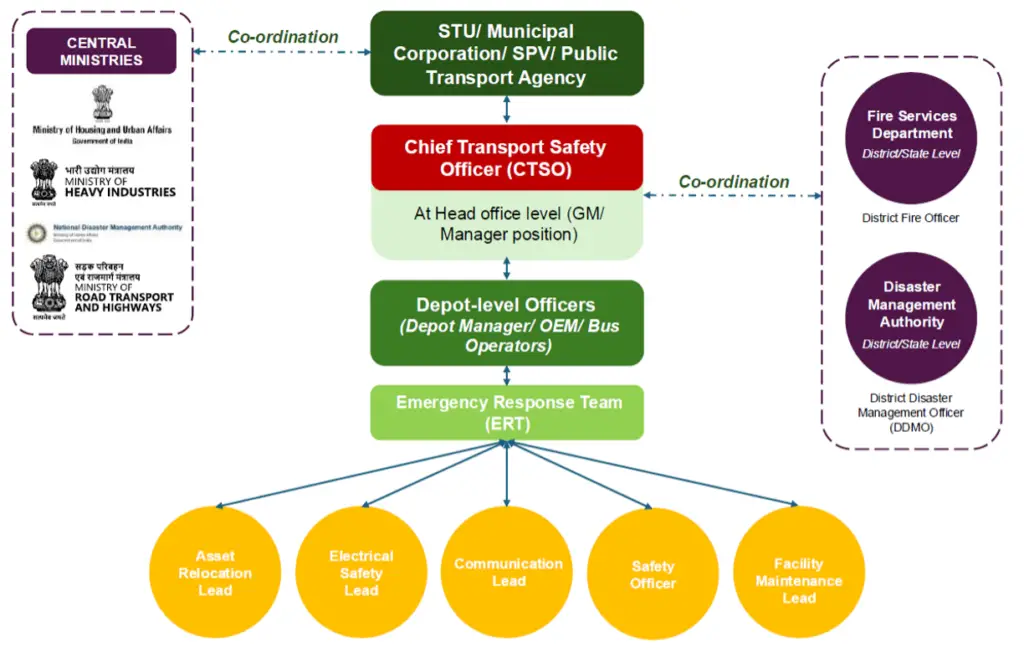
A single designated safety official, called Chief Transport Safety Officer (CTSO) is advised to be appointed in the State Transport Undertaking (STU) / Municipal Corporation / Special Purpose Vehicle (SPV) / Public Bus Transport Agency to streamline safety management and support the achievement of clear accountability.

The role is intended to streamline safety management through a centralised structure. Its implementation does not necessarily require entirely new hiring. Agencies may leverage existing personnel and roles, aligning them with the proposed institutional framework and assigning additional responsibilities where feasibleHowever, for critical functions requiring dedicated oversight, creation of new positions may be considered. 
Q1. What is the primary purpose of appointing a Chief Transport Safety Officer (CTSO) in an STU/SPV?
Q2. Which combination best represents the three safety pillars operating under the CTSO?
Q3. What is the key objective of establishing a depot-level Emergency Response Team (ERT)?
Q4. Why is post-incident review and national-level documentation of e-bus safety incidents important?
  1. Disaster Preparedness & Risk Mitigation
    • Develop and maintain safety and disaster management protocols for e-bus operations.
    • Encourage integration of climate resilience measures in depot design and operations.
  2. Coordination & Communication
    • Serve as the liaison between transport agencies and stakeholders such as the Fire Department, Disaster Management Authority (DMA), OEMs, and operators.
    • Facilitate timely information exchange and decision-making during emergencies.
  3. Emergency Response Oversight
    • Support the activation of emergency protocols during incidents such as fires, floods, or cyberattacks.
    • Coordinate on-ground response teams to assist with passenger safety and asset protection.
  4. Training & Capacity Building
    • Organise periodic training and mock drills for staff involved in disaster response
    • Recommend safety induction for new staff prior to deployment.
  5. Preventive Maintenance & Safety Audits
    • Promote regular safety inspections of buses, depots, and charging infrastructure.
    • Encourage alignment with OEM safety recommendations and standards.
    • Facilitate quarterly audits and annual third-party evaluations to assess safety compliance.
  6. Regulatory & Policy Compliance
    • Support adherence to applicable safety regulations and environmental norms.
    • Update policies based on evolving risks and technologies.
  7. Post-Incident Review & Improvement
    • Conduct reviews of incidents to identify root causes and suggest preventive measures.
    • Revise protocols based on lessons learned.
  1. Fleet Safety Coordinator
    • Supports monitoring of on-road operations and encourages driver alignment with safety protocols.
    • Collaborates with the control room during emergency situations.
    • Maintains records related to fleet inspection and operational readiness.
  1. Depot Safety Coordinator
    • Contributes to making depot infrastructure disaster-resilient and aligned with safety standards.
    • Facilitates oversight of storage, maintenance, and repair activities with a safety-oriented approach.
    • Assists in developing and updating evacuation plans and emergency exit strategies.
  1. Charging Infrastructure Safety Coordinator
    • Supports monitoring of charging operations and promotes electrical safety practices.
    • Coordinates with power utilities and OEMs to enable safe recovery in case of hazards.
    • Encourages adherence to battery handling, cooling, and fire prevention measures.

A dedicated Emergency Response Team (ERT) is to be established in Public Bus Transport Agencies under Depot-level officers (Depot Manager/OEM Bus Operator) 

The ERT consists of the following designated roles, each with clearly defined responsibilities:

  1. Asset Relocation Lead
    • Supports identification and prioritization of movable assets (e.g., buses, equipment, data records).
    • Facilitates safe relocation of electric buses, charging units, and auxiliary equipment.
    • Helps maintain asset relocation maps and contingency plans.
  2. Electrical Safety Lead
    • Assists in isolating high-voltage systems and encourages adherence to Lockout/Tagout (LOTO) procedures.
    • Coordinates with utility providers and internal electrical teams.
    • Participates in periodic electrical hazard assessments and emergency drills.
  3. Communication Lead
    • Supports internal and external communication during emergency situations.
    • Encourages timely dissemination of alerts, instructions, and status updates.
    • Engages with local authorities, emergency services, and media as needed.
  4. Safety Officer
    • Contributes to monitoring safety practices during emergency operations.
    • Promotes the use of personal protective equipment (PPE) and alignment with safety protocols.
    • Maintains incident logs and assists with post-event reviews.
  5. Facility Maintenance Lead
    • Aids in maintaining the operational integrity of critical infrastructure (e.g., ventilation, fire suppression, lighting).
    • Coordinates emergency repairs and utility restoration efforts.
    • Helps keep facility layout and emergency access plans updated.

At the national level, EV-specific safety and disaster provisions can be effectively integrated into existing policies and standards. The Urban Transport Department under MoHUA can further strengthen the ecosystem by leading a centralised system to monitor and document e-bus safety incidents, enabling post-incident reviews and continuous learning. Additionally, establishing a national empanelment of certified third-party safety auditors would enhance independent, consistent, and high-quality safety oversight across public bus transport systems.

Download Report